
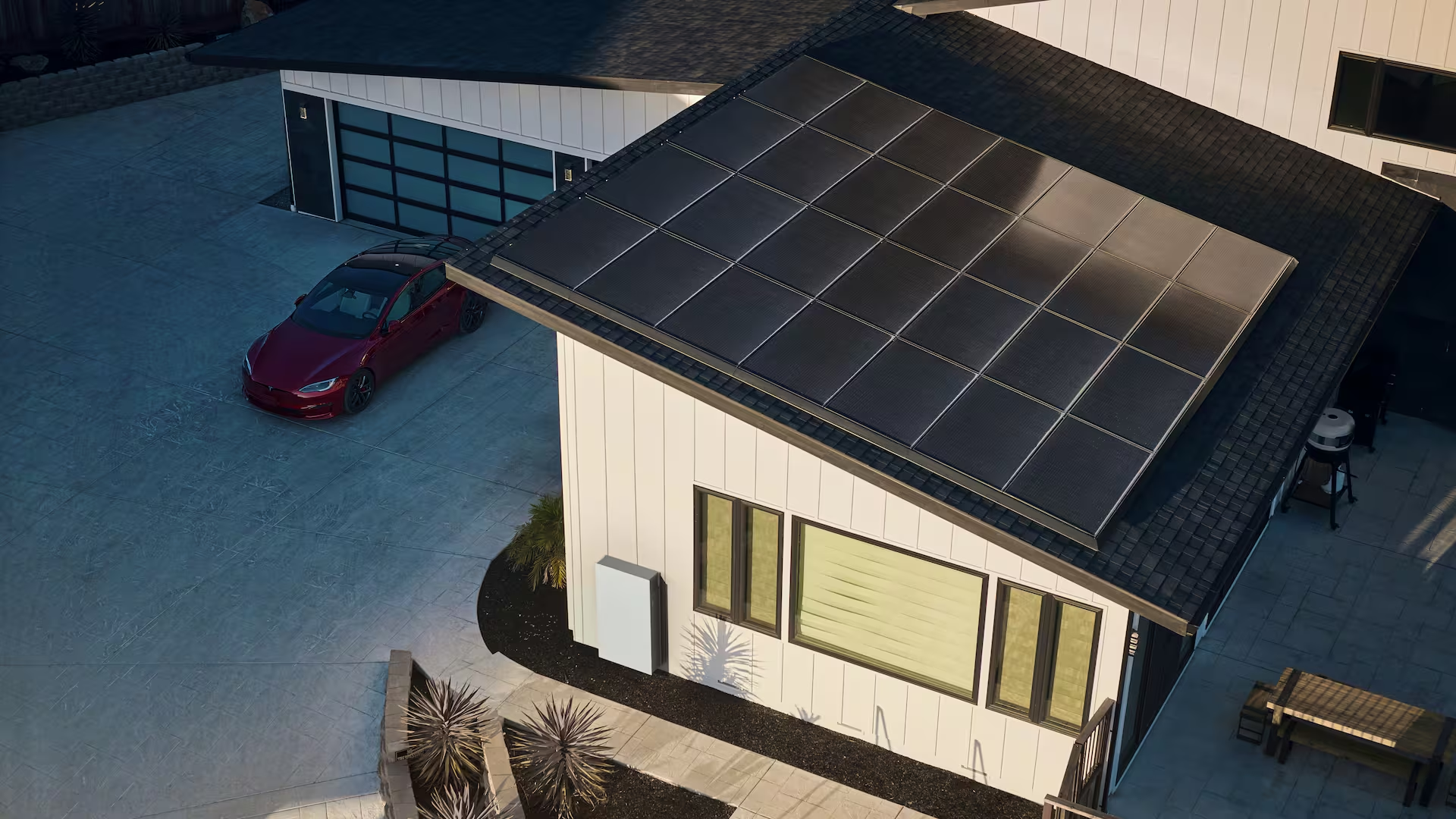
Solar Energy Agreement Texas 2026: The $0-Down Path to 30% Federal Savings in 2026
The federal residential solar tax credit expired December 31, 2025. Here is exactly how Dallas–Fort Worth homeowners still capture 30% federal savings in 2026 through a Solar Energy Agreement — and the hard deadline that closes the door.
For nearly two decades, the path for a Texas homeowner to go solar was straightforward: buy the system with cash or a loan, claim 30% of the cost back from the IRS under Section 25D, and enjoy decades of lower utility bills. That path closed on December 31, 2025.
Under the One Big Beautiful Bill Act signed by Congress on July 4, 2025, the residential solar tax credit was eliminated for any system placed in service after that date. Homeowners in Dallas, Fort Worth, Plano, Frisco, McKinney, Arlington, Denton, and across the ERCOT grid who purchase solar directly in 2026 no longer receive a federal credit of any amount.
The economics of residential solar did not disappear — they restructured. A parallel provision of the Internal Revenue Code, Section 48E, remains fully active for commercial entities through 2027. As detailed in our Complete Guide to Solar Power Purchase Agreements, this third-party ownership structure allows a qualified financing company to install, own, and maintain the panels on your roof, enabling them to claim the 30% Investment Tax Credit and transfer the savings directly into the rate you pay.
What a Solar Energy Agreement Actually Is
A Solar Energy Agreement is a long-term contract between a homeowner and a third-party solar financing company. The financing company installs a complete solar system on your roof at no upfront cost, retains ownership of the panels, inverters, and associated hardware throughout the term, and handles all maintenance, monitoring, and performance guarantees. You pay a fixed rate for the electricity the system produces — typically 20% to 40% below the prevailing utility rate in Oncor or CenterPoint Energy territory.
Because a commercial entity owns the system, that entity is eligible to claim the 30% federal Investment Tax Credit under Section 48E of the Internal Revenue Code. The financing company also captures MACRS depreciation, a separate commercial tax benefit unavailable to individual homeowners. Combined, these incentives reduce the owner's net system cost by 40% or more. A portion of that savings is priced directly into the rate offered to you.
How the 30% Federal Credit Flows to You
A Solar Energy Agreement provider purchases and installs your solar system. The provider claims the 30% ITC plus MACRS depreciation on their federal tax return. Those tax benefits reduce the provider's net cost basis in your system. That reduced cost basis is reflected in a lower per-kilowatt-hour rate offered to you. You do not claim any tax credit yourself — the savings are embedded in your rate from day one.
Tax implication: You do not report a solar energy agreement on your federal tax return. The financing company claims all tax benefits. No credit or deduction is available to you as the system owner. This is by design and is explicitly contemplated under Section 48E.
Why This Structure Exists in 2026 (and Why It Did Not in 2024)
The tax code bifurcated in 2026. Section 25D, which governed residential clean energy, was sunset by the One Big Beautiful Bill Act. Section 48E, which governs commercial clean electricity investment, was preserved. Congress did this deliberately: the policy goal was to shift federal subsidies toward larger-scale deployment channels while retaining a pathway for residential adoption through third-party ownership.
The effect for Texas homeowners is counterintuitive but consequential. In 2024, buying solar outright was the most cost-effective long-term strategy. In 2026, it is the most expensive. A direct cash purchase now loses access to all federal incentives, while a Solar Energy Agreement preserves full 30% savings.
| Tax Structure | Section 25D (Residential) | Section 48E (Commercial) |
|---|---|---|
| Status | Expired December 31, 2025 | Active through December 31, 2027 |
| Eligible Owner | Individual homeowner (cash/loan purchase) | Commercial entity (third-party ownership) |
| Federal Credit | 30% — now ZERO for 2026+ systems | 30% — fully available through 2027 |
| MACRS Depreciation | Not available | Available (20%+ additional value) |
| Who Claims Benefits | The homeowner (on tax return) | The financing company (on tax return) |
| How Homeowner Benefits | N/A in 2026 (no tax benefits available) | Embedded in lower per-kWh agreement rate |
How a Solar Energy Agreement Works in Oncor Territory
For homeowners in the Dallas–Fort Worth Metroplex, the mechanics of a Solar Energy Agreement integrate directly with Oncor Electric Delivery's interconnection process and rebate program. The sequence is predictable when working with a qualified partner (refer to our Texas Solar Energy Agreement Installer Guide 2026):
Home Energy Consultation
A licensed solar designer analyzes 12 months of your Oncor usage data, evaluates roof orientation, shading, and structural capacity, and calculates the optimal system size.
System Design & FEOC Compliance
Design uses tier-1 FEOC-compliant panels (Silfab, REC Group, or Qcells) and inverters meeting domestic content requirements for Section 48E eligibility.
Solar Energy Agreement Contract
Homeowner signs long-term agreement with financing company. Terms typically span 20-25 years with defined transfer options at year 5 or 6.
City Permitting & Oncor Interconnection
Installer submits electrical permits (Dallas/Plano 2-3 weeks; Frisco 2-4; McKinney 3-4; Denton 3-5; FW/Arlington 4-6) and files Oncor agreement. FEOC compliance must be documented.
Installation (1-3 Days)
Physical install with strict NEC compliance. If battery storage or SPAN Smart Panel included, integrated during this phase.
City Inspection & Oncor Approval
City inspector verifies code compliance. Oncor approves interconnection. System is energized.
Construction Completion
The system had to be fully constructed and operational (not just permitted) on or before July 4, 2026 for Section 48E 30% credit qualification.
The full process from signed agreement to operational system typically takes 4 to 8 weeks in DFW. Construction had to begin on or before July 4, 2026 for the financing company to claim the 30% Section 48E credit. Because permitting alone can take 3 to 6 weeks and final inspection/energization adds 1-2 more weeks, the practical deadline for starting the consultation process is approximately mid-May 2026.
Solar Energy Agreement vs. Direct Purchase: The 2026 Math
Consider a typical 8 kW residential solar installation in Oncor territory. System cost at current market pricing runs approximately $2.35 to $2.85 per watt installed, or roughly $19,000 to $22,800 before any incentives.
| Factor | Direct Purchase 2026 | Solar Energy Agreement 2026 |
|---|---|---|
| Upfront Cost | $19,000–$22,800 | $0 |
| Section 25D Federal Credit | $0 (expired) | N/A |
| Section 48E Credit Benefit | Not applicable | 30% captured by owner, passed to rate |
| MACRS Depreciation | Not available to homeowner | Captured by owner, passed to rate |
| Year 1 Monthly Cost | Loan: ~$180–$220/mo | Per-kWh: 8–12¢/kWh (typically 30% below utility) |
| Maintenance | Homeowner responsibility | Financing company (25-year coverage) |
| Ownership Timeline | Immediate ownership | Transfer option year 5–6, full ownership after |
The direct purchase scenario loses access to all federal tax benefits — a swing of roughly $5,700 to $6,800 in lost savings compared to the pre-2026 environment. The Solar Energy Agreement structure captures that value through the Section 48E commercial tax credit pathway and delivers it back to you as a reduced electricity rate.
The Oncor Rebate: How It Stacks With a Solar Energy Agreement
In addition to the federal Section 48E credit flowing through a Solar Energy Agreement, Dallas–Fort Worth homeowners in Oncor Electric Delivery territory can access the 2026 Oncor Solar Photovoltaic Standard Offer Program. The program provides rebates up to $9,000 for qualifying solar-plus-storage systems.
Critical 2026 requirement: battery storage is mandatory for all solar installations to qualify. Solar-only installations no longer receive any Oncor incentive. The battery must be at least 5 kWh of usable capacity. Systems combining solar with a Tesla Powerwall 3, Enphase IQ battery, or equivalent LFP battery chemistry storage solution fulfill this requirement.
A typical Oncor rebate structure in 2026 allocates approximately $3,500–$4,500 to the solar component and $4,500–$5,500 to the battery component, depending on system size. The rebate is paid directly to the installer and reflected as a discount on your invoice — or, in the case of a Solar Energy Agreement, as a reduction in the system's cost basis that further lowers your per-kilowatt-hour rate.
Why Solar-Plus-Storage Is Now the 2026 Standard in Texas
Texas has become the fastest-growing solar-plus-storage market in the United States. According to the Q1 2026 U.S. Energy Storage Market Outlook from the Solar Energy Industries Association, Texas is on track to surpass California as the #1 battery storage market in 2026. ERCOT recorded more than 15,000 MW of installed battery storage capacity as of late 2025, and residential storage deployments grew 51% year-over-year.
The reasons are structural. Texas residential electricity demand has grown approximately 30% since 2020, driven by AI data centers, cryptocurrency mining, and industrial expansion. ERCOT demand is forecast to grow 9.6% in 2026 alone. The grid remains vulnerable during summer peaks and winter storms — the average Texas home experiences approximately 48 hours of outages per year, and wholesale prices for winter peak periods are trending upward through 2029.
Against that backdrop, solar panels alone deliver incomplete value. Without battery storage, excess solar production is pushed to the grid at low buyback rates (Texas has no mandatory net metering). With battery storage, that production is captured and used at night, during peak-rate hours, or during outages. A Tesla Powerwall 3 (13.5 kWh, LFP chemistry, 11.5 kW continuous output) or Enphase IQ battery integrated with solar transforms the economics and adds grid resilience.
What to Verify Before Signing a Solar Energy Agreement
Not all Solar Energy Agreements are equivalent. To avoid any misrepresentation, evaluate these terms with the same rigor you would apply to any Solar Energy Agreement Contract in Texas 2026:
- Initial rate versus utility comparison: Year 1 rate should be 20-40% below current Oncor all-in rate (currently 15.26¢/kWh). Target: 8-12¢/kWh for 2026 Texas contracts.
- Annual escalator: Typical 2026 options are 0.99%, 1.99%, or 2.99% per year. Compare against Oncor's historical trend and review standard Solar Energy Agreement Escalators in Texas 2026 to validate long-term value.
- Ownership transfer terms: Confirm year 5 or 6 buyout option, valuation methodology (not vague "fair market value"), and warranty transfer details.
- Home sale transferability: Confirm buyer qualification criteria, transfer fees, and any restrictions. Below-market rates are typically attractive to buyers.
- Performance guarantee: System should guarantee minimum production. If underperformance occurs, company compensates or repairs at no cost.
- Equipment warranties: Panels (25 years standard), inverters (10-15 years), batteries (10 years). Confirm transfer if ownership transfers at year 5-6.
- Maintenance coverage: All repairs, inverter replacements, monitoring, and performance guarantees included for 20-25 year term.
- FEOC compliance documentation: Confirm panels, inverters, and batteries meet Section 48E domestic content requirements for company's tax credit claim.
Who a Solar Energy Agreement Is Right For
A Solar Energy Agreement is not universally the best choice. The structure suits homeowners who:
- Plan to stay in their home for at least 5-10 years — the compounding savings require time to fully monetize.
- Do not have the tax liability to benefit from a direct cash purchase (even if Section 25D were still available).
- Prefer predictable monthly costs over upfront capital deployment and long-term maintenance responsibility.
- Want to protect against rising Oncor rates and the expected 45% increase in ERCOT wholesale prices projected for 2026.
- Are financing other major home priorities (mortgage, renovation, education) and cannot free up $19,000–$30,000 in upfront capital.
Homeowners with strong liquidity who plan to own long-term and value full asset ownership may still prefer a cash purchase — accepting the loss of federal tax credit in exchange for 100% asset equity, the Texas property tax exemption, and no long-term contract obligation.
The Hard Deadline: Why May 2026 Is the Practical Decision Point
Section 48E required project construction to begin before July 4, 2026. That deadline has now passed, and missing it — even by a single day — forfeits access to the 30% federal Investment Tax Credit entirely. Because the credit is the structural foundation of a Solar Energy Agreement's pricing advantage, projects that miss the deadline lose their primary economic rationale.
The practical timeline for a DFW homeowner working backward from July 4, 2026:
- Consultation and system design: 1–2 weeks
- Contract review and signing: 1 week
- City permit acquisition: 3–6 weeks depending on jurisdiction
- Oncor interconnection application: Concurrent with permitting
- Construction start: Had to occur on or before July 4, 2026 to satisfy Section 48E
Adding a buffer for permitting delays, contract negotiation, and design revisions, the functional deadline to begin the consultation process is mid-May 2026. Homeowners who wait past early June 2026 face material risk of missing the credit window.
Model Your 2026 Savings Before the Section 48E Window Closes
A 15-minute consultation with our team analyzes your last 12 months of Oncor usage, projects your savings under a Solar Energy Agreement versus direct purchase, confirms your Oncor rebate eligibility, and shows your exact monthly cost and long-term net present value against the December 31, 2027 in-service deadline that now applies.
Schedule Free ConsultationFrequently Asked Questions
What is a Solar Energy Agreement in Texas?
A Solar Energy Agreement is a long-term contract where a third-party financing company installs, owns, and maintains solar panels on your roof at zero upfront cost. You pay a fixed rate per kilowatt-hour (typically 8-12 cents vs. 15+ cents from Oncor), and the financing company claims the 30% federal Section 48E tax credit, passing savings to you via lower rates.
Why did Section 25D solar tax credit expire in 2026?
The One Big Beautiful Bill Act (signed July 4, 2025) eliminated the Residential Clean Energy Credit (Section 25D) for systems placed in service after December 31, 2025. Congress shifted federal subsidies to third-party ownership structures via Section 48E (Commercial Clean Electricity Investment Credit), which remains active through 2027.
How does Section 48E benefit me if I sign a Solar Energy Agreement?
Under Section 48E, the financing company claims the 30% Investment Tax Credit and captures MACRS accelerated depreciation (roughly 20% additional value). These tax benefits reduce the company's cost basis, which is reflected directly in the lower per-kilowatt-hour rate you pay—you capture the savings without claiming the credit yourself.
What is the July 4, 2026 deadline for Section 48E?
Section 48E required that construction begin on or before July 4, 2026 to claim the full 30% federal Investment Tax Credit. Projects that begin after this date lose access to the credit entirely. For DFW homeowners, this means initiating the consultation and permitting process by mid-May 2026 to meet the deadline.
How much can I save with a Solar Energy Agreement versus Oncor rates?
A typical Solar Energy Agreement in Texas offers rates of 8-12 cents per kilowatt-hour, compared to Oncor's current average of 15.26 cents (April 2026). This is a 20-40% reduction, and the difference compounds over 20-25 years as utility rates rise while your agreement rate rises only 0-3% annually via the escalator.
Is a Solar Energy Agreement the same as a solar lease?
No. A solar lease charges a fixed monthly payment regardless of production. A Solar Energy Agreement (PPA) charges per kilowatt-hour consumed, tying your payment directly to system performance (see our guide on Solar Lease vs PPA in Texas 2026). In sunny Texas, PPAs typically deliver more predictable value and are easier to transfer if you sell your home.
Can I combine a Solar Energy Agreement with the Oncor rebate?
Yes. The 2026 Oncor Solar Photovoltaic Standard Offer Program provides up to $9,000 in rebates for qualifying solar-plus-storage systems. The 2026 program now requires at least 5 kWh of battery storage (Tesla Powerwall 3 or Enphase IQ). The rebate is applied to reduce the system cost basis, further lowering your per-kWh rate.
What happens to my Solar Energy Agreement if I sell my home?
Solar Energy Agreements are transferable by design. When selling a home with a solar energy agreement, the buyer can assume the remaining contract terms after passing a soft credit check. Many buyers view a below-market fixed electricity rate as an asset that adds home value. Confirm transfer terms and fees with your provider before signing.
Do Solar Energy Agreement rates increase every year?
Most 2026 agreements include an annual escalator of 0.99%, 1.99%, or 2.99%. Even with a 3% escalator, rates remain well below projected Oncor increases—Texas rates rose 4.4% from 2025 to 2026, and ERCOT wholesale prices are forecast to rise 45% in 2026. Some providers offer flat-rate contracts with no escalator.
What does FEOC compliance mean for my solar system?
FEOC (Foreign Entity of Concern) compliance is a 2026 requirement for Section 48E. At least 40% of project costs must come from domestically manufactured components. This affects panel selection (Silfab, REC Group, and Qcells panels typically qualify; some foreign panels may not). Installers ensure compliance automatically.
Can I add battery storage to a Solar Energy Agreement?
Yes. Most 2026 Solar Energy Agreements include battery storage as standard because the Oncor rebate requires it. A Tesla Powerwall 3 (13.5 kWh, LFP chemistry) or Enphase IQ battery integrated with solar provides grid outage protection, peak shaving on time-of-use rates, and qualifies for the $4,500-$5,500 battery portion of the Oncor rebate.
Who is responsible for maintenance and repairs under a Solar Energy Agreement?
The financing company owns and maintains the system throughout the 20-25 year term. All costs—inverter replacements, panel repairs, monitoring software, performance guarantees—are their responsibility. You have no maintenance obligations or out-of-pocket costs for the full contract term.
RESIDENTIAL ENERGY SOLUTIONS — DESTINED ENERGY
A complete suite of home energy services across DFW and Texas: residential solar panel installation, Solar Energy Agreement (third-party ownership financing), Tesla Powerwall 3 battery storage, Tesla EV Level 2 charger installation (Tesla Universal Wall Connector), Tesla Cybertruck Powershare bidirectional charging setup, SPAN Smart Panel integration, and full solar services including panel maintenance, repair, diagnostics, and professional solar panel detach & reinstall for roof replacements.
COMMERCIAL & UTILITY SOLAR — DESTINED ENERGY
Large-scale solar delivery for Texas businesses and developers: commercial solar installation for offices, retail, warehouses, and industrial sites, plus utility-scale solar projects interconnected to ERCOT. Section 48E strategy, MACRS depreciation guidance, and turnkey project management from engineering through commissioning.
COMMERCIAL ELECTRICAL — DNRG ELECTRICAL CO.
DNRG Electrical Co. is the commercial electrical division and DBA of Destined Energy LLC, operating under the same TECL #38062 license. DNRG delivers three core commercial services statewide in Texas — with a special concentration in DFW: ground-up commercial electrical construction for new developments (offices, retail centers, warehouses, medical facilities, industrial buildings), tenant finish-out electrical installation (restaurants, retail, medical, offices, fitness), and electrical service work including commercial panel upgrades, troubleshooting, and equipment power installations. All work is NEC-compliant, fully insured, and delivered in strict coordination with general contractors, developers, and property managers.