
Level 2 EV Charger Installation in Dallas-Fort Worth, Texas
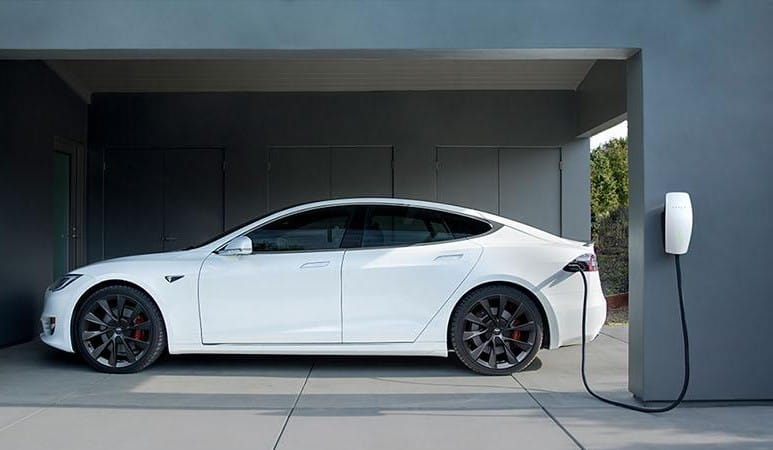
Skip the unpredictable lines at public stations and fuel your daily commute from the comfort of your own garage. Destined Energy provides expert residential EV charging solutions tailored specifically for DFW homeowners. From high-performance hardware to complete home energy ecosystems, our licensed electricians ensure a safe, code-compliant, and seamless setup.
Tesla Certified Level 2 installation for any EV — Tesla Wall Connector, J1772 universal, NEMA 14-50 outlets, 50A hardwired. Permit-pulled, Oncor-coordinated. TECL #38062. Serving all 25 DFW cities.
Designed for Any Property
Convenience Charge Anytime
Installation Fast and Flexible
Cost of Ownership Energize Your Savings
A Level 2 EV charger charges your electric vehicle 5–10× faster than a standard 120V outlet — typically 25–35 miles of range per hour versus 3–5. Destined Energy installs Tesla Wall Connectors, universal J1772 stations, and NEMA 14-50 outlets across Dallas-Fort Worth under TECL #38062. Permits pulled, Oncor coordinated, panel-sized correctly the first time. Typical DFW install: 4–8 hours, $1,400–$2,800 turnkey, or $0 upfront when bundled with a Solar Power Purchase Agreement.
Ventajas principales

Independencia energética: Conecta tu cargador a paneles solares para dejar de depender de la red eléctrica.

Tecnología inteligente: Controle el consumo de energía en tiempo real desde su teléfono y programe la recarga durante las horas de menor consumo.

Totalmente compatible: Cargadores de nivel 2 (240 V) y carga rápida de CC, compatibles con todas las marcas.
Ahorros garantizados: Reducción de costos de hasta 40% en comparación con la gasolina.

Certificaciones premium: Electricistas certificados por Tesla, SPAN y Enphase.
Hardware
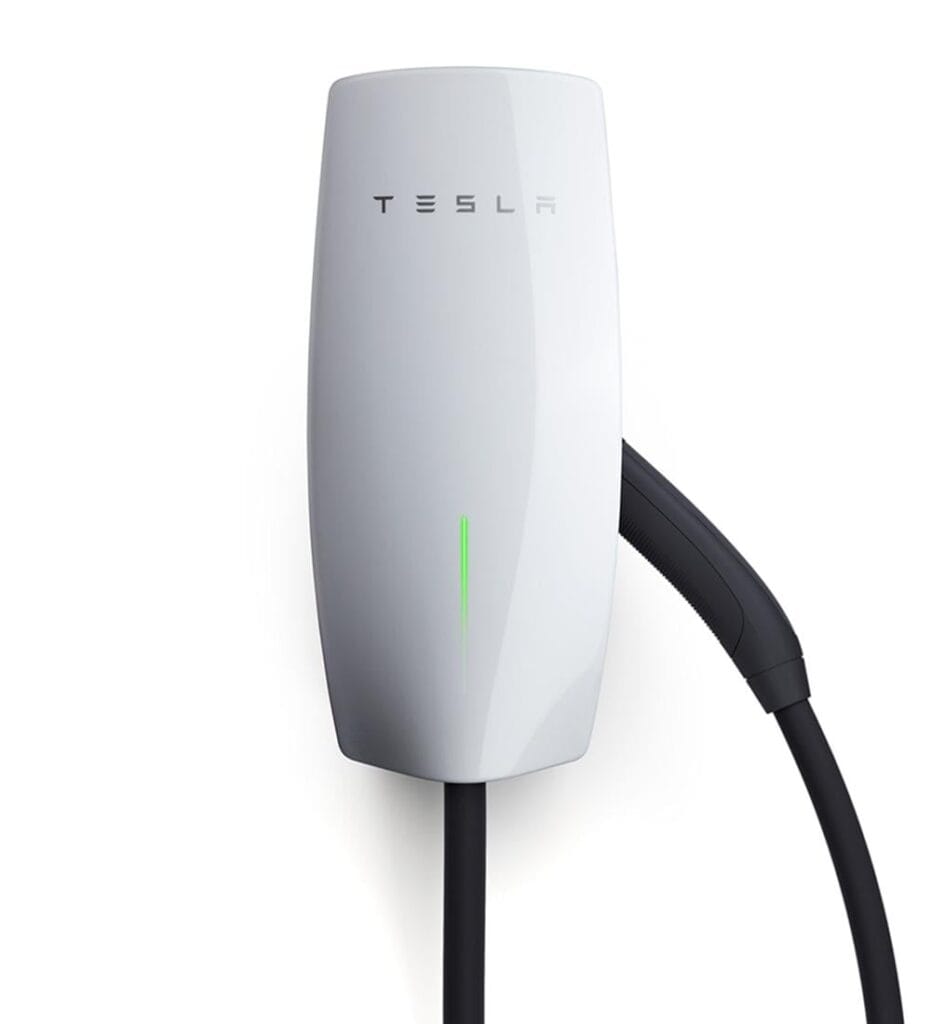
Power output - 22kW*
On a single phase power supply, the Tesla Wall Connector adds around 30 miles of range per hour of charger – perfect for taking advantage of any energy savings offered by your overnight utility pricing.
Got a three phase power supply? The Tesla Wall Connector can charge even after, adding around 60 miles of range per hour of charge.
Connectivity - WiFi
For the first time, the Tesla Wall Connector connects to WiFi, allowing it to receive over-the-aire firmware updates as well as offer support for non-tesla vehicles to charge and set up charging schedules via the Tesla app.
Cable Type - 7.3 metre (type 2)
Thanks to the Tesla Wall Connector’s perminantly attached 7.3 metre cable, you won’t have to worry about needing to have a cable handy.
And here’s a cool trick: the Wall Connector’s cable has a button at the end. One press, and the charging port of a nearby Tesla vehicle pops open, saving you the hassle of fumbling through the app.
Dimensions - H345mm x W155mm x D110mm
The third generation Tesla wall charger has seen huge improvements to the look, size and weight. It still leaves a visually striking impression, but goes about it with slightly more discretion.
Dimensions – H345mm x W155mm x D110mm
Weight – 6.8kg
Software
Smart scheduling - Yes
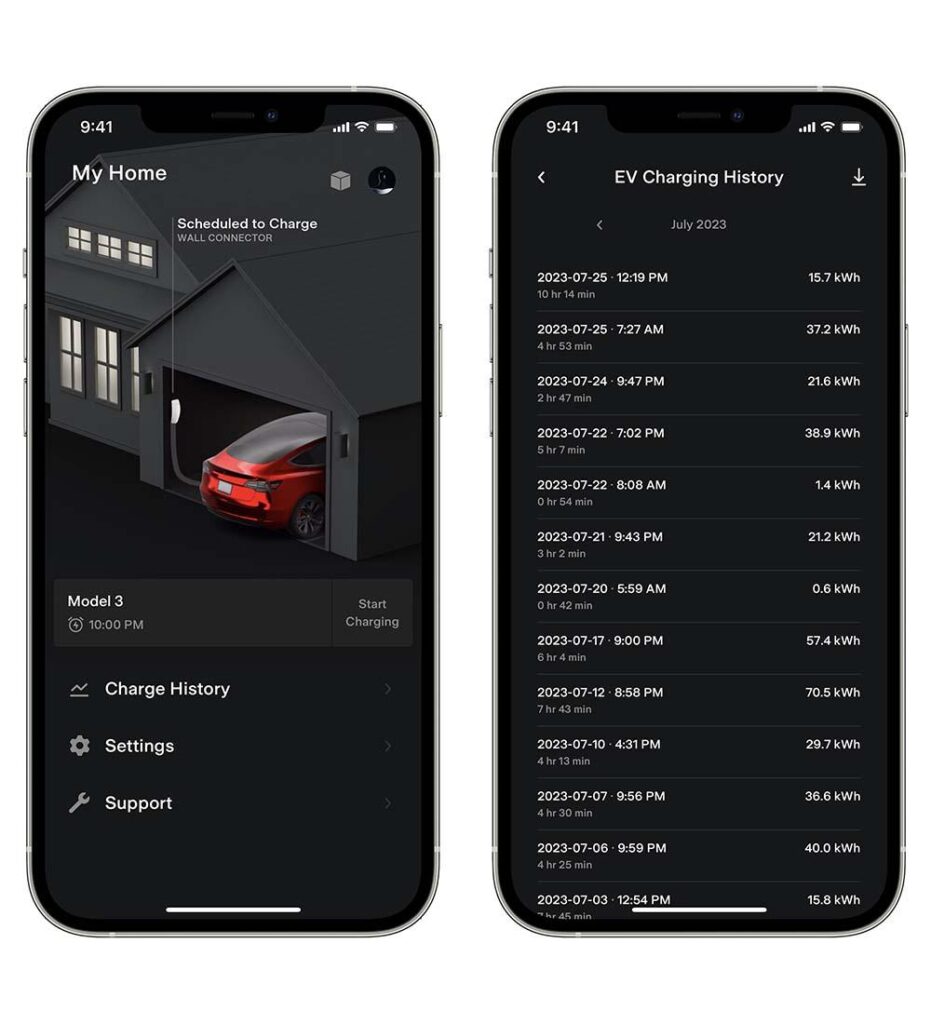
Set your charge sessions to coincide with the off-peak rate of your electricity tariff. This can be done via the Tesla app or in your Tesla vehicle.
Non-Tesla users can still set charging sessions albiet via the app only.
Cost Tracking - Yes (Tesla vehicle owners only)
Monitor your charging expenses with the cost tracking feature in the Tesla app, available exclusively for Tesla vehicle owners.
Over the air firmware updates
Just like Tesla vehicles, the Wall Connector continuously receives software improvements, automatically delivered via firmware updates over WiFi.
FASTER HOME CHARGING
| The Paradigm Shift: Why a Tesla Level 2 Installation is Essential
Relying on a standard 120V outlet is unsustainable for Texas drivers, taking up to 50 hours for a full charge and creating unnecessary range anxiety. Upgrading to a dedicated Tesla level 2 installation is the definitive solution, delivering up to 44 miles of range per hour on a robust 240V circuit. You can plug in after work and wake up with a 100% full battery. Our engineering team custom-designs the conduit and wiring path, seamlessly integrating maximum power without compromising your home’s aesthetic.
| Maximize Efficiency with Solar EV Charging Integration
UNIVERSAL COMPATIBILITY
| The Universal Solution: Not Just an EV Charger Tesla
A common misconception is that Tesla hardware is restricted solely to Tesla vehicles. While the standard EV charger Tesla Wall Connector is the absolute pinnacle of design, Destined Energy caters to every electric vehicle on the road. We expertly install the Universal Wall Connector, which features an integrated, lockable J1772 adapter. It allows you to charge any North American EV—like Ford, Rivian, or Hyundai—from the exact same station, building a future-proof charging infrastructure for your garage.
EXPERT SAFETY PROTOCOLS
| Why Trust Our Certified Home EV Charger Installers?
Installing a 240V, 48-amp continuous load circuit places extreme stress on your electrical panel and wiring. Unlicensed installations can lead to severe fire hazards, thermal throttling, and immediate municipal code violations. As dedicated and certified home ev charger installers, we conduct a rigorous total load calculation to ensure your main breaker safely handles the amperage. Furthermore, we navigate the complex DFW bureaucracy, pulling the required permits and passing city inspections so you can charge with absolute peace of mind.
Trusted EV Charger Installers Across North Texas
Ready to Power Your Drive?
Destined Energy is committed to building a smarter, cleaner, and more resilient driving infrastructure for Texas homeowners. As certified home EV charger installers, we deliver an engineering-grade, turnkey experience by handling all municipal permits, load calculations, and city inspections for you. Every installation is future-proofed for all North American EV brands (NACS & J1772) and fully protected by a comprehensive 2-year workmanship warranty.
Operating locally across the entire Dallas-Fort Worth Metroplex, we provide premium residential installations tailored to your home’s energy needs. We proudly serve communities throughout the region, including:
Dallas | Fort Worth | Frisco | Plano | Arlington | Denton | Southlake | McKinney | Keller | The Woodlands
Licensed (TECL #38062) • Tesla Certified • 5.0★ Google Rating • Serving all of DFW
Level 2 EV Charger Installation DFW FAQs
How much does it cost to get an EV charger installed in Dallas-Fort Worth?
Most DFW Level 2 EV charger installations run an estimated $1,400–$2,800 turnkey — which covers the charger hardware, a dedicated 240V circuit, pulling the permit, labor, and the city inspection. A NEMA 14-50 outlet install (without the charger) typically runs about $600–$1,200. If you need a long conduit run, figure an extra $400–$900. A full panel upgrade can add roughly $2,500–$4,500. Or, bundle it with a Solar Power Purchase Agreement and the EV charger install is rolled right into the project at $0 upfront. Keep in mind, these are ballpark figures; we provide exact pricing after a site evaluation.
What is a Level 2 EV charger and why do most homeowners choose it?
A Level 2 EV charger uses a 240V circuit (just like an electric range or dryer) to juice up your electric vehicle 5–10× faster than a standard 120V Level 1 plug. We’re talking 25–35 miles of range per hour compared to a measly 3–5 miles. For your typical DFW commuter doing 30–40 miles a day, a Level 2 charger gets you topped off in under 90 minutes. The U.S. Department of Energy notes that over 80% of EV charging happens at home, making Level 2 the go-to standard for residential setups.
Can any regular electrician install an EV charger?
Technically, yes — any licensed Texas electrician (TECL) can run the wire for a Level 2 charger. But if you’re putting in a Tesla Wall Connector, ChargePoint, Wallbox, or another smart unit, you really want a manufacturer-certified installer. Registering the warranty, getting the software commissioned, and handling load management all require manufacturer credentials. Destined Energy is Tesla Certified, SPAN Authorized, and Enphase Certified — putting us in the most-credentialed tier of installers in DFW.
Is the federal IRS tax credit for EV charger installation still around in 2026?
No. It expired for property placed in service after June 30, 2026. Section 30C — the Alternative Fuel Vehicle Refueling Property Credit — covered 30% of EV charger installation costs for systems placed in service on or before June 30, 2026, up to $1,000 for residential setups, provided your home is in an eligible census tract. A lot of DFW non-urban and low-income tracts fit the bill, including big chunks of Fort Worth, Garland, Mesquite, Grand Prairie, and Irving. Destined Energy even hands you a pre-filled IRS Form 8911 when the job’s done. You can check your address using the Treasury Department’s Census Tract Eligibility Tool.
What's the difference between a Tesla Wall Connector and a universal J1772 charger?
The Tesla Universal Wall Connector (rolled out in 2024) charges Tesla vehicles using the proprietary NACS plug AND handles any non-Tesla EV with a built-in J1772 adapter — pushing 48A continuous, 11.5 kW max. On the flip side, a universal J1772 charger (like a ChargePoint Home Flex, Wallbox Pulsar Plus, or Emporia Pro) is the standard plug for Ford, Hyundai, Chevy, Nissan, Rivian, and other non-Tesla models — though Tesla owners can still use it with the adapter Tesla gives you. If you’ve got a mixed garage with a Tesla and a non-Tesla, the Universal Wall Connector is your best bet for a future-proof setup.
What is the 80/20 rule for EV charging?
It actually means two different things depending on who you ask. NEC 80/20 continuous-load rule (the installer definition): according to National Electrical Code §625.41, an EV charger is a continuous load, meaning the circuit breaker has to be sized 25% larger than the charger’s constant draw. So, a 48A charger needs a 60A breaker, and a 32A charger needs a 40A breaker. Battery 80/20 rule (the driver definition): for everyday driving, keeping your EV battery charged between 20% and 80% is the best way to extend its lifespan. You really only want to bump it to 100% when you’re hitting the road for a long trip.
Do I need to upgrade my electrical panel to get a Level 2 charger?
A lot of the time, no. A Level 2 charger requires roughly 40–60A of dedicated capacity. If your current 200A main panel has 40+ amps of room to spare (which is common in newer DFW homes), you’re good to go. If your panel is maxed out, you’re looking at two options: a full service upgrade (estimated at $2,500–$4,500) or dropping in a SPAN Smart Panel (estimated at $3,500–$5,000), which smartly manages your power to make room for the charger without a service upgrade. Destined Energy runs the NEC §220 load calc for free when we put together your quote.
How long does an EV charger installation take in DFW?
From signing the contract to plugging in for the first time, you’re generally looking at 7–10 days across most DFW municipalities. The breakdown: free quote (24 hours) → pull the permit (3–5 business days) → the actual install (4–8 hours, knocked out in one visit) → city inspection (1–3 business days) → ready to charge. Destined Energy gets the inspection scheduled and we’re there to meet the inspector, so you don’t have to burn PTO. Cities like Plano, Frisco, and Southlake usually move 1–2 days faster than Dallas proper because their permit offices turn things around quicker.
Can I charge my EV straight from my solar panels?
Absolutely, if you’ve got the right setup. When you tie together solar panels, a Tesla Powerwall 3, an EV charger, and a SPAN Smart Panel, your vehicle can pull power directly from your roof during the day, which means you aren’t paying Oncor a dime for that juice. Any extra power gets stashed in the Powerwall for overnight charging. A typical Tesla Model Y driver can save an estimated $80–$150 a year just on charging costs with this rig. Destined Energy can bundle the whole package into a single Solar Power Purchase Agreement install.
What is a NEMA 14-50 outlet and is it good enough for EV charging?
A NEMA 14-50 is a 50-amp, 240V plug — the exact same kind you’d use for a heavy-duty electric range or plugging in an RV. It can handle Level 2 charging up to 32A continuous (that’s a 40A breaker × 80% NEC continuous-load rule). It’s a bit slower than a hardwired 48A unit, but it gets the job done for most folks’ overnight charging needs. It’s also the most affordable install option (estimated at $600–$1,200). It’s a solid choice if you’re renting or planning to move in a few years, but remember you’ll need to purchase a portable Level 2 cable separately (like the Tesla Mobile Connector for $300, or a generic brand for $150–$250).
Does the EV charger have to be in the garage, or can it go outside?
Either spot works fine for most top-tier Level 2 chargers. Units like the Tesla Universal Wall Connector, ChargePoint Home Flex, Wallbox Pulsar Plus, and Emporia Pro are all NEMA 4 rated (meaning they’re built to handle the weather) and are rated to operate from -22°F all the way up to 122°F — more than tough enough for DFW weather. Just note that an outdoor install usually tacks on an estimated $200–$500 over a garage install because we have to use weatherproof conduit, specialized junction boxes, and longer wire runs. We generally suggest putting it in the garage if possible, just to keep the equipment out of the elements and extend its life.
Do I really need a permit to install an EV charger in Texas?
Yes, you absolutely do. Every municipality in our DFW service area requires an electrical permit for a hardwired Level 2 charger, in accordance with the Texas Building Code §1612 and local city rules. Trying to bypass the permit isn’t just illegal, it can void your homeowner’s insurance if there’s an electrical fire. Destined Energy handles all the permitting under our TECL #38062 license; you don’t have to mess with any city paperwork. Permits normally clear in 3–5 business days around here.
Does putting in an EV charger add value if I'm going to sell my house?
Most real estate agents in DFW look at a Level 2 EV charger as a solid selling point that can reduce the time a home sits on the market, especially for properties listed above $400,000. Data from Zillow’s 2024 home features report indicated that listings highlighting EV charging sold an average of 9 days faster. While the charger won’t necessarily bump your official appraised value, taking advantage of the Section 30C tax credit (30% off, up to $1,000) made the upfront cost easier to swallow for installs completed on or before June 30, 2026, no matter how long you plan to stay in the house.
Can I write off my EV charger as a business expense?
If the charger is being used for a business fleet vehicle or installed at a commercial site, then yes — the commercial side of the Section 30C credit covered 30% up to $100,000 per charger for property placed in service on or before June 30, 2026, and you can still depreciate the equipment using MACRS under IRC §168. If you’re mixing personal and business use, you calculate the deduction based on the business percentage. If it’s strictly a home install for a personal car, you’re looking at the residential Section 30C credit (30% up to $1,000), which ended for property placed in service after June 30, 2026, and standard depreciation doesn’t apply. Always double-check with your CPA — Destined Energy gets you the Form 8911 documentation, but we aren’t tax advisors.
If the Oncor grid fails, can I still charge my EV?
Only if you’ve got battery backup tied into the system. A regular Level 2 charger pulls directly from the Oncor grid, meaning if the grid drops, your charging stops. However, if you pair a Tesla Powerwall 3 with a SPAN Smart Panel, the system can route battery power to keep the charger online during a blackout. And with Tesla Cybertruck Powershare, the truck’s massive 11.5 kWh battery can actually power your house during an outage. After Winter Storm Uri knocked out power to 4.5 million accounts across Texas in February 2021, setting up an integrated solar + battery + EV rig became the standard move for DFW homeowners who want real resilience.
Can I get an EV charger installed if I rent an apartment or live in a condo with an HOA?
Under Texas Property Code §202.018 (which passed in 2023), most condo and townhome owners have the legal right to install an EV charger in a deeded parking spot, provided they go through the HOA’s architectural review process and cover the costs themselves. If you’re a renter or don’t have a deeded spot, you have to get permission from the property owner. Destined Energy regularly handles HOA approval packets in places like Frisco, Plano, Southlake, Highland Park, and University Park. For property managers looking to install networked Level 2 stations (like ChargePoint or FLO) across 4–20 units with tenant billing, DNRG Electrical Co. (our commercial division) handles those larger setups.